

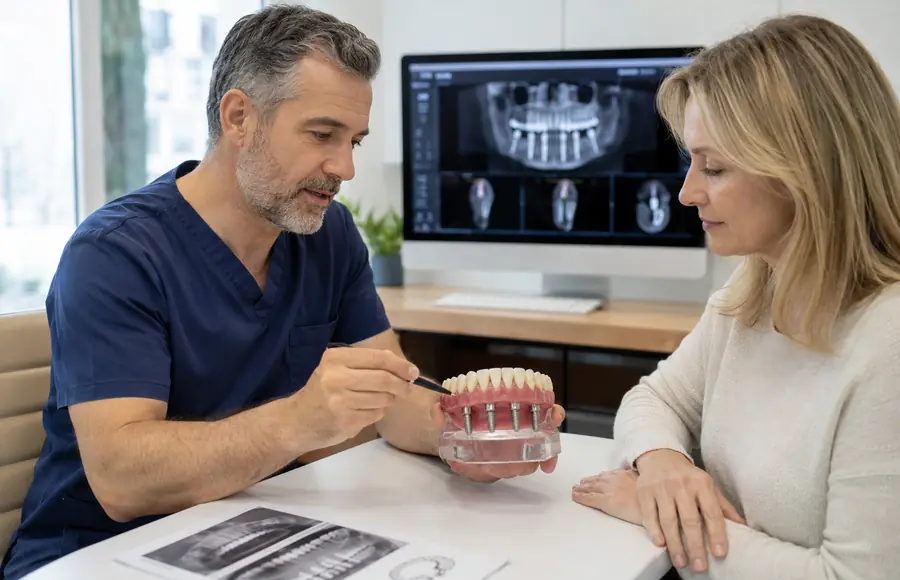
What does All-on-4 mean?
All-on-4 describes a treatment approach rather than one universal product. Four implants are positioned to support a full upper or lower arch of replacement teeth. The number, angle and position of implants are planned around the available bone, bite and proposed prosthesis.
Who might consider it?
It may be discussed with people who have lost most or all teeth in one arch, already wear a full denture, or have remaining teeth with a poor prognosis. It is not automatically suitable for everyone. The clinical team must assess gum health, bone volume, bite, medical history, smoking, cleaning ability and expectations.
Immediate and final teeth
Some patients can receive a fixed temporary bridge soon after implant placement. "Teeth in a day" normally describes a provisional restoration, not completion of all treatment. A final bridge is usually made after healing and may use different materials. Immediate loading depends on adequate implant stability and clinical judgement.
Benefits and limitations
The approach can provide fixed teeth using fewer implants than some other full-arch designs. It is often discussed for people with limited bone who wish to avoid grafting procedures such as sinus lifts; in that situation the back implants may be deliberately tilted rather than placed vertically. Consensus reviews have found no significant difference in survival between tilted and axial implants, or between fewer than five and five or more implants, but reviews of the All-on-4 literature also note limited follow-up and study quality.
It remains major restorative treatment. Risks include surgical complications, implant failure, infection, altered sensation, fracture or wear of the temporary or final bridge, speech or cleaning difficulties, and later maintenance or repair costs. Losing one implant can affect the whole design.
Questions to ask a clinic
- Why are four implants appropriate for my anatomy and bite?
- Which teeth will be removed, and what alternatives exist?
- Is the advertised bridge temporary or final?
- What materials and number of teeth are included?
- How will I clean beneath the bridge?
- Who provides review, repairs and urgent support after I return home?
This article provides general educational information. It does not diagnose a dental condition or confirm that a treatment is suitable for you. A dentist must assess your mouth, health and appropriate imaging before giving personalised advice. Treatment methods, timings, risks and inclusions vary between patients and clinics.
Sources and further reading
- International Team for Implantology — Number of Implants Placed for Complete-Arch Fixed Prostheses (opens in a new tab): consensus statement finding no significant difference in implant or prosthesis survival between fewer than five, five and more than five implants.
- International Team for Implantology — Tilted versus axial implants (opens in a new tab): consensus statement on tilted and axial implants in full-arch fixed prostheses, including common prosthetic complications.
- International Team for Implantology — Loading protocols for fixed prostheses in edentulous jaws (opens in a new tab): consensus statement on immediate, early and conventional loading, including the importance of implant stability and case selection.
- Soto-Peñaloza et al., 2017 — The all-on-four treatment concept: systematic review (opens in a new tab): reports high implant survival over short- to medium-term follow-up; the authors note limited study quality and follow-up.
- Guy's and St Thomas' NHS Foundation Trust — Dental implants (opens in a new tab): patient information on what implants are, alternatives, treatment stages, risks and long-term care.