

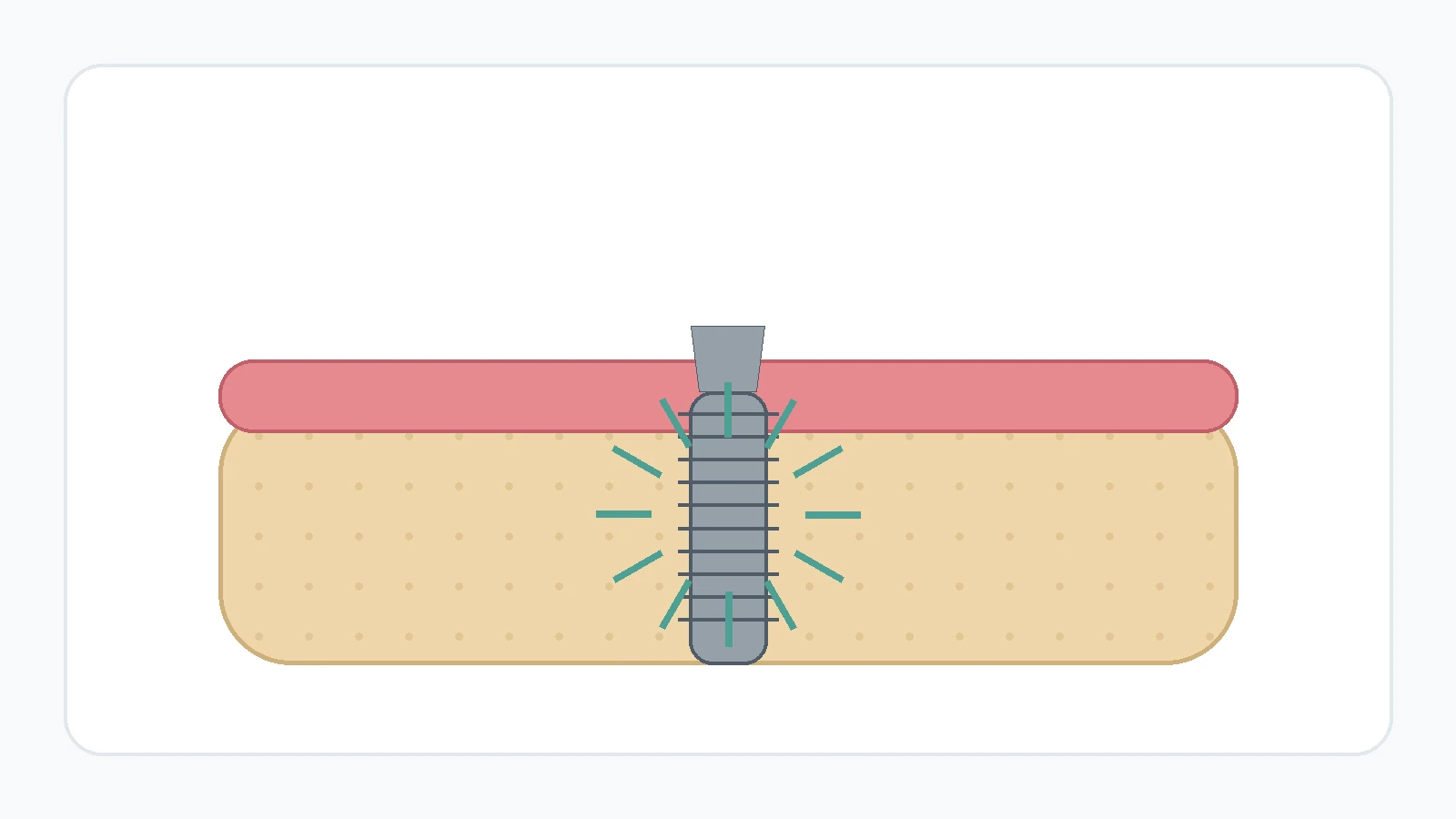
Osseointegration is the biological process by which living bone forms a stable connection with the surface of a dental implant.
It is one of the key processes that allows an implant to become stable enough to support a crown, bridge or full-arch restoration.
What happens after an implant is placed?
A dental implant is inserted into prepared bone.
Immediately after placement, the implant has primary stability, which comes from the mechanical fit between the implant and the bone.
Over the following weeks and months, bone remodels around the implant surface.
As healing progresses, new bone forms close contact with the implant. This developing biological stability is what is meant by osseointegration.
Why is osseointegration important?
An implant needs a stable connection with the surrounding bone so that it can withstand the forces created during normal function.
If adequate osseointegration does not occur, the implant may remain mobile or fail to function as intended.
That is why clinics monitor implant healing before or during later stages of treatment.
How long does osseointegration take?
There is no single healing time that applies to every implant.
Healing depends on factors such as:
- implant location
- bone quality and quantity
- whether grafting was performed
- implant stability at placement
- the type of restoration used during healing
- general health and individual healing response
- smoking and other risk factors
- whether complications develop
Your treating dentist decides when an implant is ready for the next stage based on the specific case.
Does the implant have to remain unused while it heals?
Not always.
Some implants are left unloaded during healing.
In other cases, a temporary restoration may be fitted soon after surgery. This is often called immediate loading or immediate provisionalisation, depending on the situation.
Even when temporary fixed teeth are fitted, the implants are still going through biological healing.
The temporary restoration may be designed to reduce the forces placed on the implants during this period.
Can you feel osseointegration happening?
No.
Osseointegration happens within the bone and does not produce a specific sensation that tells you it is complete.
Feeling comfortable does not prove that healing is complete, and discomfort does not automatically mean that osseointegration has failed.
Assessment is based on the treating clinician's examination and other clinical findings.
What can interfere with osseointegration?
Many factors may affect implant healing.
Examples can include:
- excessive movement of the implant during healing
- infection or inflammation
- smoking
- poorly controlled medical conditions
- unsuitable loading
- reduced bone quantity or quality
- surgical or biological complications
This does not mean that one risk factor automatically causes failure.
Implant outcomes depend on the overall clinical situation.
What happens if osseointegration does not occur?
If an implant does not achieve stable integration, the treating dentist may need to remove it.
What happens next depends on the reason, the condition of the site and the wider treatment plan.
Possible next steps may include a healing period, additional treatment to the site, or consideration of another implant later.
Only the treating clinician can advise what is appropriate for an individual case.
How does this relate to two-visit full-arch treatment?
In many full-arch treatment pathways, implants are placed on the first visit and temporary teeth are used during healing.
After a healing period, the patient returns for assessment and the next restorative stages.
The second visit is not simply a calendar date. The clinic needs to decide that healing and implant stability are suitable for the planned next step.
In simple terms
Osseointegration means bone becoming stably connected to the implant surface during healing.
It is a biological process that develops over time and is central to the long-term stability of dental implants.