

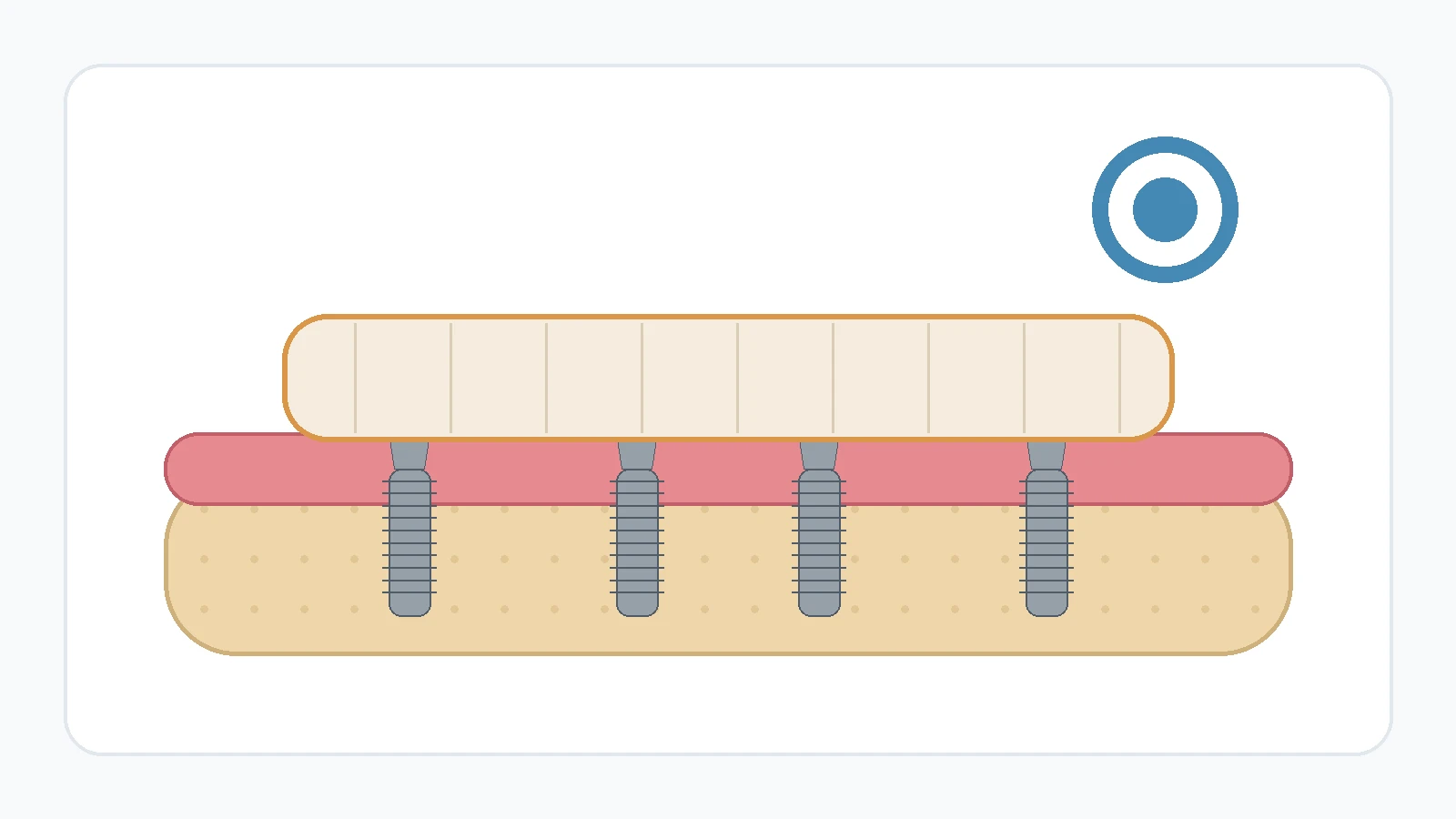
PMMA stands for polymethyl methacrylate.
It is an acrylic material widely used in dentistry, particularly for temporary or provisional restorations.
In implant treatment, PMMA is often used for temporary full-arch teeth worn while implants and surrounding tissues heal.
Why is PMMA used for temporary teeth?
PMMA can be shaped, adjusted, polished and repaired relatively easily compared with many definitive restorative materials.
That makes it useful during a stage when the patient's bite, gum shape and implant healing may still be changing.
A provisional restoration can be modified before the final restoration is produced.
Is PMMA always temporary?
PMMA is strongly associated with provisional restorations, but dental materials and designs vary.
A clinic should explain whether the PMMA restoration is intended as:
- a short-term temporary
- an interim restoration for several months
- part of a longer-term treatment design
Patients should not assume that every PMMA restoration has the same intended lifespan.
Is PMMA the same as zirconia?
No.
PMMA is an acrylic polymer. Zirconia is a ceramic material.
They differ substantially in material properties, manufacturing and typical use.
In many full-arch implant pathways, PMMA may be used during healing and a different material may be chosen for the definitive bridge.
Can PMMA break or wear?
Yes.
Like other dental materials, PMMA can wear, fracture or require adjustment.
The risk depends on factors including restoration design, thickness, bite forces, tooth grinding or clenching, the number of supporting implants and how the restoration is used and maintained.
A repairable provisional material can be useful during healing, but that does not mean breakage should be ignored.
Why might PMMA appear on a quote?
A treatment plan may list:
- provisional PMMA bridge
- PMMA temporary teeth
- immediate provisional restoration
- acrylic temporary bridge
The wording may differ between clinics.
When comparing quotes, check whether temporary teeth are included, whether they are fixed or removable, what material they are made from, whether more than one temporary set is included, and whether repairs or adjustments are included.
Also check what material is planned for the final restoration.
Does PMMA contain metal?
PMMA itself is a polymer, not a metal.
However, a PMMA restoration may be used with a separate reinforcing framework or implant components made from other materials.
That is why the material named for the visible teeth does not necessarily describe every part of the restoration.
In simple terms
PMMA is an acrylic dental material commonly used for provisional teeth, especially during the healing stages of implant treatment.
If a clinic says “temporary teeth included”, ask whether those teeth are PMMA, how they are supported and how long they are intended to be used.