

What is a zirconia crown?
A crown covers and protects a tooth that has been weakened, heavily restored, fractured or changed in shape or appearance. Zirconia is a ceramic material valued for strength and a tooth-coloured appearance. It can be used as a solid ("monolithic") restoration or layered with porcelain, and the different designs balance strength and appearance differently.
When might a crown be considered?
A dentist may recommend a crown when a tooth cannot be reliably restored with a filling or other conservative option. The tooth and gums must be assessed first. Some teeth need root-canal treatment, a core build-up or gum treatment, but these are separate procedures and should not be assumed from the crown alone.
What does treatment involve?
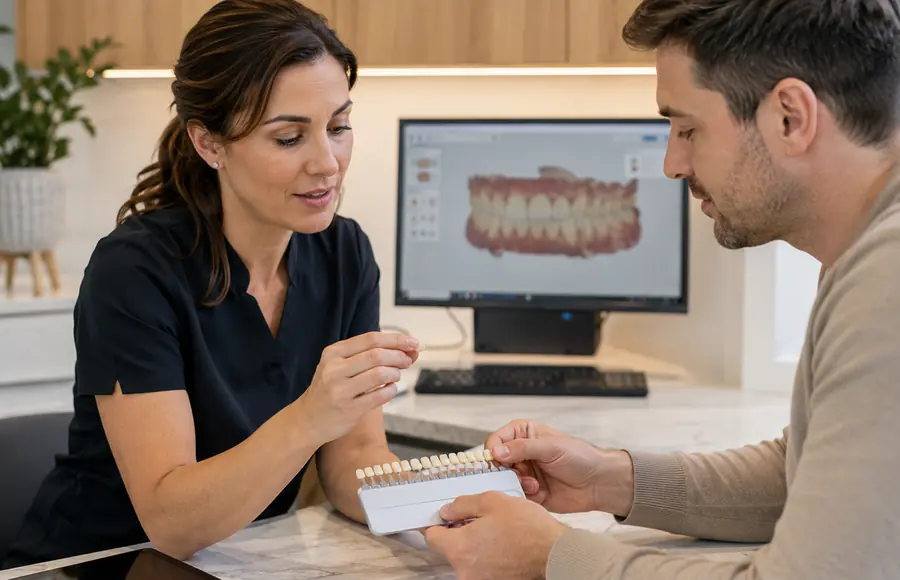
The tooth is prepared to create space for the crown, and a scan or impression is taken. A temporary crown may be fitted while the laboratory makes the final restoration. The dentist then checks fit, bite, contacts, shape and colour before cementing it. Implant crowns follow a different preparation and connection process.
Benefits and limitations
Zirconia can be strong and metal-free, but the best material depends on tooth position, bite, remaining tooth tissue and cosmetic priorities. Any crown involves irreversible preparation of a natural tooth. Possible problems include sensitivity, decay at the margin, gum inflammation, chipping, loosening, bite discomfort or later root-canal treatment. Crowns are not permanent: NHS patient information suggests a properly cared-for crown should normally last around 8–10 years.
Research on ceramic crowns is still developing. A systematic review of implant-supported all-ceramic crowns found similar short-term survival for zirconia designs but significantly more ceramic chipping in layered (veneered) crowns than in solid (monolithic) ones; the authors noted short follow-up for monolithic zirconia.
Questions to ask a clinic
- Why is a crown preferable to a filling, onlay or veneer?
- Is it monolithic or layered zirconia?
- Are temporary crowns, core build-ups and laboratory fees included?
- How will colour and bite be checked?
- What aftercare is needed if sensitivity, loosening or fracture occurs?
This article provides general educational information. It does not diagnose a dental condition or confirm that a treatment is suitable for you. A dentist must assess your mouth, health and appropriate imaging before giving personalised advice. Treatment methods, timings, risks and inclusions vary between patients and clinics.
Sources and further reading
- NHS — Dental treatments (opens in a new tab): overview of crowns, veneers, bridges, dentures and implants, including that a crown is a cap that completely covers a real tooth and that the tooth must be shaped to fit it.
- Leeds Teaching Hospitals NHS Trust — Crowns (opens in a new tab): patient information on when crowns are used, materials, temporary crowns, aftercare and expected lifespan.
- Systematic review and meta-analysis — survival, failure and complication rates of veneered and monolithic all-ceramic implant-supported single crowns (opens in a new tab): compares ceramic designs, including zirconia, and reports higher chipping rates for veneered crowns.